


 BEST BRAND

 BEST SELLER
 FIND STORE NEARBY
 WARRANTY REGISTRATION
A good mattress keeps your spine in a straight line, spreads pressure at the shoulders and hips, breathes well, and has a firmness that suits your body weight and sleeping position. No single type of mattress is best for everyone, which is why people with back pain, side sleepers and heavier sleepers each suit a different kind of mattress.
The quickest way to decide is to start with yourself, then look at materials. Begin with your usual sleeping position, your body weight and any issues you already have, such as back pain or sleeping hot. Next, choose between spring, latex, foam or a hybrid, and finish by picking a size that fits your room and your budget. The sections below walk through each step in this order.
What Makes a Good Mattress: 5 Criteria
Before you get to brands or models, use these five criteria to make your decision. Whichever mattress meets all five within the budget you are comfortable with is the answer to which type of mattress is best for you.
Supports Your Spine's Natural Alignment
A mattress with good body support keeps your hips, waist and shoulders on the same plane as when you stand up straight. Lie on your back and slide your hand under your waist: there should be only a small gap. If your whole palm slides in easily, the mattress is too firm; if your hips sink so deep that your back arches, it is too soft.
Spreads Pressure at the Shoulders and Hips
Your shoulders and hips carry the most weight while you sleep. If a mattress does not spread that pressure well, blood flow is restricted, so you toss and turn more often and wake up sore. Materials that contour to your body, such as latex and memory foam, handle this noticeably better than ordinary firm foam.
Breathes Well for Thailand's Climate
Thailand is hot and humid almost all year, and a mattress that traps heat leads to lighter sleep and waking up in the night. Spring layers have air pockets that let air flow through best, followed by latex, which has natural pores in the rubber. If you choose memory foam, look for a model with a gel layer or a cooling layer.
Resists Sagging and Lasts a Long Time
A sag-resistant mattress comes down to two things: material density and a structure that supports weight evenly across the whole surface. Good-quality latex on the market is usually around 70 to 110 kg per cubic meter, while for spring mattresses you should check the coil gauge and whether the comfort layer is thick enough. In general, a good-quality mattress lasts around 7 to 10 years, and genuine latex often lasts longer, at around 8 to 15 years.
Does Not Disturb Your Partner When You Turn
If you share a bed, motion transfer matters a lot. A pocket spring mattress, with each spring working independently, absorbs movement right where it happens, so your partner barely notices when you get up for the bathroom at night. A continuous-coil spring, by contrast, carries movement across the whole mattress.
How Many Types of Mattresses Are There, and How Do They Differ?
Mattresses sold in Thailand fall into five groups by their main material, and each one has a clearly different feel and strengths. Read the short description of each type first, then check the comparison table at the end of this section.
Spring and Pocket Spring Mattresses
A spring mattress is the type Thai people know best. It feels firm with a noticeable push-back, makes turning over easy and breathes well. A continuous-coil spring links all the coils together across the whole mattress, making it affordable and good at carrying weight. A pocket spring wraps each spring in its own separate pocket, so it gives point by point to your body's shape and reduces motion transfer to your partner much better.
Latex Mattresses
A latex mattress feels firm yet soft and springs back quickly, supporting your body evenly across the whole surface without forming dips. Natural pores in the latex help it breathe well and resist dust mites. It is one of the longest-lasting options, in exchange for being heavier and pricier than a spring mattress of the same grade.
Memory Foam Mattresses
A memory foam mattress softens in response to body heat and weight, hugging the curves of your body more closely than any other type. That makes it a good fit for people with shoulder or hip pain from side sleeping. The trade-off is that it recovers more slowly than latex and holds more heat, so choose a model with a cooling layer.
HD Comfort Foam Mattresses
An HD Comfort foam mattress uses high-density foam that gives even firmness across the whole surface. It is lightweight, easy to move and the most affordable option, suited to rented rooms, extra beds, guest rooms, or anyone who wants a firm mattress on a tight budget.
Hybrid Latex Spring Mattresses
A latex spring mattress places a latex layer on top of a spring core, so you get the support and airflow of springs plus the soft, contouring surface of latex. It is a well-balanced choice for couples who prefer different firmness levels, or for anyone who wants latex but finds an all-latex feel too dense.
|
Mattress type |
Feel |
Breathability |
Strengths |
Best for |
|
Spring and pocket spring |
Firm, springy, clear push-back |
Excellent, with air pockets in the spring layer |
Carries weight well, easy to turn over, pocket springs reduce motion transfer |
People who like a firm feel, couples, entry-level budgets |
|
Latex |
Firm yet soft, quick to recover |
Good, with natural pores in the latex |
Even full-body support, long lifespan, resists dust mites |
People with back pain, allergy sufferers, people who want long-term use |
|
Memory foam |
Soft, contouring, gives with body weight |
Moderate; a cooling layer is recommended |
Best at relieving pressure points |
Side sleepers, people with shoulder and hip pain |
|
HD Comfort foam |
Evenly firm, does not sag |
Moderate |
Lightweight, affordable |
Rented rooms, extra beds, guest rooms |
|
Hybrid latex spring |
Firm spring core, soft latex surface |
Good |
Combines the strengths of both materials in one mattress |
Couples who prefer different firmness levels |
Spring or Latex Mattress: Which One Should You Choose?
Choose a spring mattress if you like a firm feel, turn over a lot, sleep hot and want an affordable price. Choose a latex mattress if you want even support across the whole surface, dust mite resistance and a longer lifespan. In general, a good-quality spring mattress lasts around 7 to 10 years, while genuine latex lasts around 8 to 15 years.
If you still cannot decide, look at the cost per year instead of the price tag. Latex costs more up front, but once you divide the price by its lifespan, the cost per year is often similar. And if you like both, the shortcut is a hybrid that places latex on top of a spring core, giving you both push-back and a contouring surface in one mattress.
Choose a Mattress Based on How You Sleep
Criteria and types are general guidance, but everyone sleeps differently. Find yourself in one of these five groups, then choose the firmness and material recommended for that group.
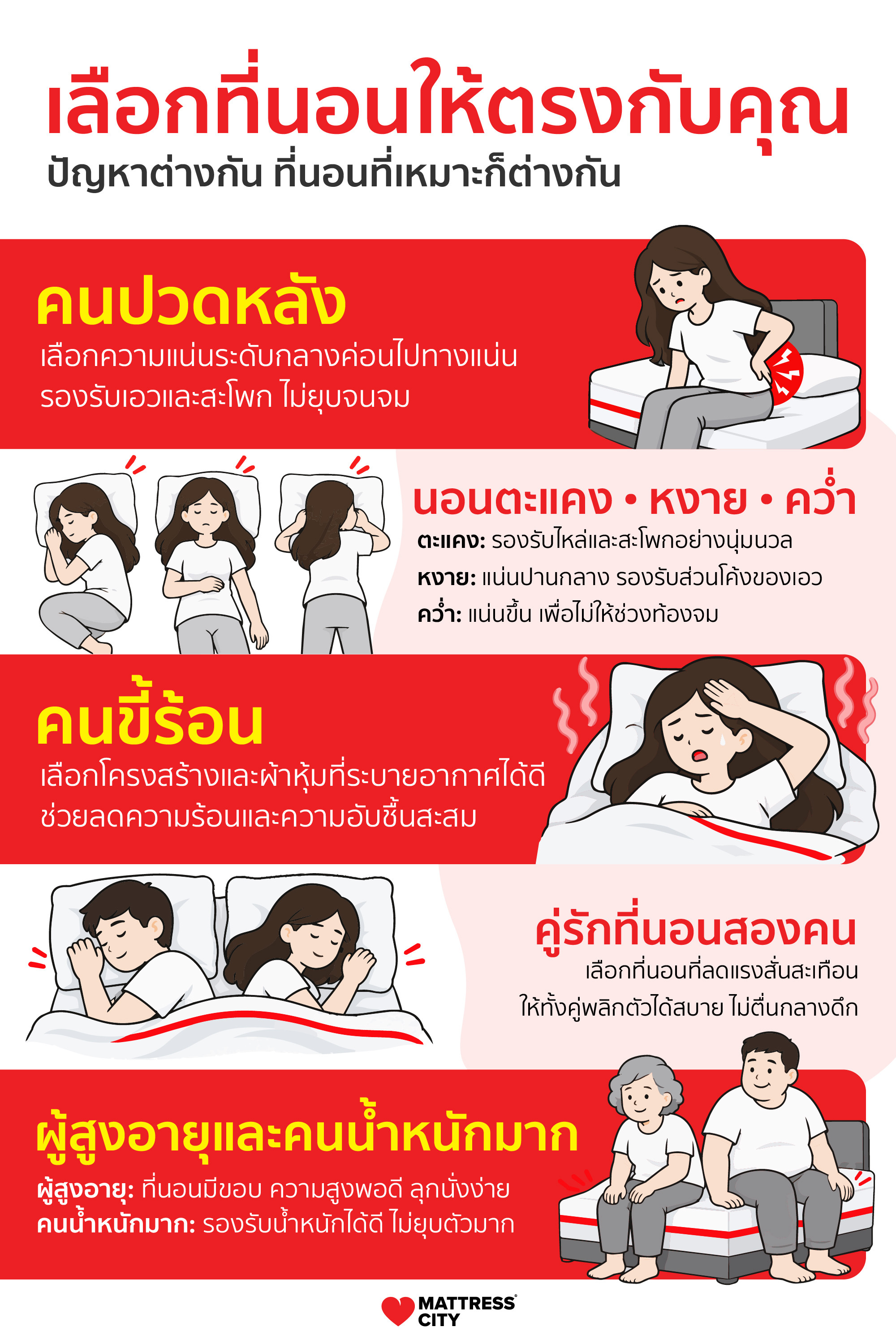
People with Back Pain
If you have back pain, avoid a mattress so soft that your hips sink and one so firm that your waist is left unsupported. Medium to medium-firm is the safest range. The materials that work best are latex or a pocket spring with zoned support. We cover symptoms and model choices in detail in our guide to health mattresses for back pain.
Side, Back and Stomach Sleepers
Side sleepers need a mattress that lets the shoulders and hips sink in a little, which makes memory foam and latex the best fit. Back sleepers suit medium firmness that still supports the curve of the lower back. Stomach sleepers should use a firmer mattress than usual so the stomach does not sink and arch the back, and should also work on the correct sleeping position alongside changing the mattress.
Hot Sleepers Who Sweat at Night
If you often wake up feeling stuffy or with a damp back, avoid all-memory-foam mattresses without a cooling layer and choose a spring or latex mattress that lets air flow through instead. A breathable mattress cover and lightweight, airy bed sheets also help. If you sweat so much that it disrupts your sleep, check the causes of night sweats before deciding to replace your mattress.
Couples Sharing a Bed
For couples, the challenges are motion transfer and preferring different firmness levels. A pocket spring handles the first best because each spring works on its own. The second can be solved by choosing a firmness halfway between what you each like, then letting the person who prefers softer add a topper on their side only. Allow for a size of at least 5 feet so each person has room to turn over.
Older Adults and Heavier Sleepers
Older adults need a mattress that is easy to get in and out of, with edges that do not sag when sitting on the side of the bed, and a combined bed and mattress height that lets their feet rest flat on the floor. Heavier sleepers should choose a thicker and firmer mattress than usual. Most people use a thickness of around 8 to 10 inches, while larger people should move up to 10 to 12 inches or more so the mattress does not sag sooner than it should.
Choose a Mattress Size That Fits Your Room
In Thailand, mattress sizes are named in feet, but you need centimeters to measure your actual room. The three best-selling sizes are 3.5 feet, 5 feet and 6 feet, as shown in this table.
|
Common name |
Actual mattress size (cm) |
Bed frame space to allow |
Best for |
|
3.5 ft (Single) |
106 x 198 |
Around 118 to 125 x 205 to 215 |
Solo sleepers, small rooms, dorms, children's rooms |
|
5 ft (Queen) |
152 x 198 |
Wider and longer than the mattress, depending on the headboard and side rail design |
Couples in a medium-sized room, or solo sleepers who like extra space |
|
6 ft (King) |
182 x 198 |
Wider and longer than the mattress, depending on the headboard and side rail design |
Couples, families with young children, large bedrooms |
The number you need for measuring your room is the bed frame size, not the mattress size. For example, a 3.5 ft mattress is 106 cm wide, but the actual bed frame usually takes up around 118 to 125 cm in width and around 205 to 215 cm in length because of the headboard and side rails. Before you order, compare the specs of the bed and mattress base you have in mind with your room space, and leave at least 60 cm of walking space on each side of the bed.
Which Mattress Brand Is Best? A Quick Comparison Before You Choose
LOTUS stands out for its complete product line, from entry-level spring models to Talalay latex, so you can find the firmness you like across a wide range of budgets. Dunlopillo stands out for the strength of its pocket spring and latex models, suiting anyone looking for point-by-point support. Omazz sits in the premium segment, focusing on high-end materials, extra thickness and long warranties. Midas is a value option for entry-level budgets that still offers a full spring structure and latex layer. If you are set on a large size, we have put together a 6 ft mattress comparison by model and price.
Recommended Mattress Models from Mattress City
Once you know which material you prefer and what size you need, the next step is matching it to your budget. The three price ranges below are selected from models actually sold in our mattress category, to show what each budget gets you.
Budget Up to 10,000 Baht
In this range, you can get a 9-inch spring mattress with a long warranty. LOTUS Otto uses a Superbonnel Adaptive spring topped with HD Comfort foam and Stress Free Foam to help relieve pressure points, with a 10-year warranty, starting at 9,113 baht. It is a great-value starting point for people who like a firm feel but still want a soft surface on top. If you can stretch your budget a little further, Dunlopillo Duchess uses a Firma Luxe Coil 3970 Series spring topped with a Body Care Topper and multiple layers of high-density foam, 9 inches thick, with an 8-year warranty, priced at 29,198 to 39,894 baht, giving you both the firmness of springs and the softness of the foam layers on top.
Budget 20,000 to 50,000 Baht
This range moves up to full pocket spring construction. Dunlopillo Celeste uses a Freedom Coil 6000 pocket spring, 8 inches thick, with a 10-year warranty, priced at 24,990 to 47,557 baht. It suits couples who want to reduce motion transfer and get serious point-by-point support. For hot sleepers who also want a pocket spring, LOTUS St.Cosmo uses a LOTUS MARSHALL COIL Series 2.0 pocket spring paired with an ICETECH Memobic topper infused with cooling particles, 11 inches thick, with a 10-year warranty, priced at 40,990 to 44,990 baht.
Premium Budget from 70,000 Baht
This range has the most layered materials. Dunlopillo Monarchy, the brand's 100th anniversary model, is 15.5 inches thick and combines a Freedom Coil 9900 Series pocket spring with 7-zone support and two layers of TalaSilver latex, with a 10-year warranty, priced at 95,050 to 98,753 baht. For latex lovers who do not want springs, Omazz Flospure is 13 inches thick and uses a Talatech latex topper over an Organique Foam core with zoned support that follows your body's shape, with a 10-year warranty, priced at 89,289 to 121,491 baht.
All prices are promotional prices at the time of checking and may change depending on the promotion period and the size you choose. We recommend checking the latest price on each model's product page before you decide.
Checklist Before You Buy a Mattress
First, try it for real. Reading specs a hundred times is no substitute for lying on it yourself. At the showroom, lie on each model in your usual sleeping position for at least 10 minutes, try turning over and sitting on the edge of the bed, and ask a Sleep Coach to check your spine alignment while you lie on your back and on your side.
Second, check the warranty terms: how many years, what is covered, and how deep a sag must be (in centimeters) to qualify for a claim. A mattress with a 10 to 15-year warranty usually reflects confidence in that model's construction.
Third, think about delivery and payment. A mattress is a large item that is hard to transport yourself, so check whether free nationwide delivery and 0% installments are available. These make it easier to move up to a model that truly suits your body without paying in one lump sum.
Finally, if your current mattress has not sagged and has not reached the end of its lifespan but feels too firm, adding a topper is a cheaper option than replacing the whole mattress. But if the mattress has sagged into a dip and you wake up with back pain every morning, a topper will not help; replacing the mattress is the only fix.
Frequently Asked Questions About Choosing a Mattress
Which type of mattress does not sag?
Genuine latex mattresses and pocket spring mattresses with a thick enough comfort layer hold their shape best, because latex springs back quickly and individually pocketed springs spread weight point by point. What makes a mattress sag quickly is low material density, sleeping in the same spot every night, and placing it on a base that does not support the whole surface.
What is the difference between a spring and a latex mattress?
They differ in structure and feel. A spring mattress uses metal coils to carry weight, giving a clear push-back, easy turning, good airflow and a more affordable price. A latex mattress uses a full layer of latex for support, giving an even firm-yet-soft feel, dust mite resistance and a longer lifespan, but it is heavier and pricier at the same quality level.
Which type of mattress helps prevent back pain?
A medium to medium-firm mattress that supports evenly across the whole surface without forming dips does the most to reduce back pain. In terms of materials, that means latex or a zoned pocket spring. The key principle is that your hips should not sink and your waist should not be left unsupported. If you already have chronic back pain, choose based on your symptoms rather than on softness.
How often should you replace your mattress?
In general, a good-quality mattress lasts around 7 to 10 years, and genuine latex often lasts longer, at around 8 to 15 years. These numbers are only a guide, so watch for real signs as well, such as the surface forming dips in the shape of your body, waking up with back or neck pain every morning, or sleeping better anywhere other than at home.
How is a pocket spring mattress different from a regular spring mattress?
A pocket spring mattress wraps each spring in its own fabric pocket, so springs compress only where weight is applied. This gives more precise body support and greatly reduces motion transfer to your partner. A regular spring links all the coils together across the mattress, so it moves as one piece and carries motion across, in exchange for a lower price and the traditional firm feel many people are used to.
Are spring mattresses any good?
Yes, and they are still the best-value choice for most people, especially those who like a firm feel, turn over often, sleep hot or are on an entry-level budget. The limitation of springs is that cheaper models with a thin comfort layer sag sooner. If you choose a model with a solid enough spring structure and a 10-year warranty, it will last just as long as other materials.
Summary: Which Type of Mattress Is Best for You?
The answer to which type of mattress is best does not lie in any single material, but in the right fit between your sleeping position, body weight, any issues you have, your room size and your budget. Use the five criteria at the start to screen your options, use the type comparison table to narrow them down to two or three models, then finish by trying them in person. If you would like someone to help you compare model by model, visit a showroom or choose online at Mattress City, with free nationwide delivery and 0% installments.